Feature Calibration
Multi-layer aggregation, normalization, and a representation-aware noise schedule prepare frozen DINO features for diffusion-based dynamics modeling.
Let the policy shape what the representation encodes,
and the world model learn how it evolves.
RoboTwin 2.0 success
Both clean and random settingsRoboDojo average score
With ~600 hours of embodied pre-trainingReal-robot success
55 successful trials out of 60Generative video pre-training
Built on frozen DINOv3 featuresTHE CENTRAL QUESTION
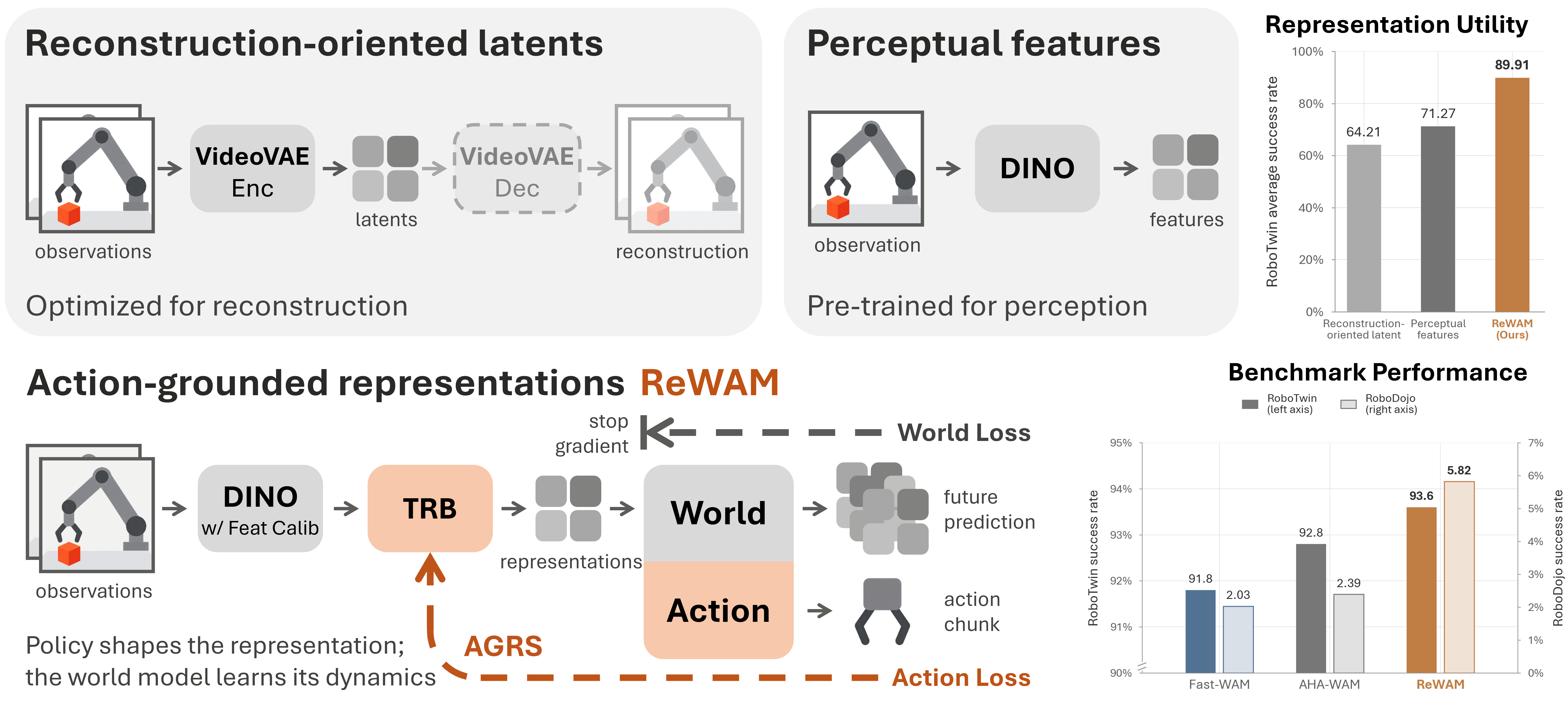
World-action models need a shared space that supports both predicting future observations and choosing robot actions. Visual reconstruction quality alone does not tell us how useful that space is for control.
ReWAM starts from frozen DINO features, calibrates them for dynamics learning, and organizes them into temporal world states. The action objective shapes these states; the world objective learns their evolution. This division of roles supports strong robot policies without generative video pre-training.
Read the full studyTHE METHOD
Three components turn perceptual features into a space for prediction and control.
Multi-layer aggregation, normalization, and a representation-aware noise schedule prepare frozen DINO features for diffusion-based dynamics modeling.
A trainable bottleneck combines paired frames across camera views into compact, 128-dimensional world-state tokens.
Only action-loss gradients update the bottleneck. World-loss gradients stop at the representations, allowing the world model to learn their dynamics.
SIMULATION BENCHMARKS
50 tasks · 100 evaluation episodes per task and setting
No embodied pre-training or generative video pre-training. Main results use five training epochs.
Five capability categories · 35 training tasks
| Method / embodied pre-training | Score ↑ | Success ↑ |
|---|---|---|
| Fast-WAM / none | 3.48 | 2.03% |
| ReWAM / none | 9.42 | 5.82% |
| Fast-WAM / ~600 h | 10.95 | 6.80% |
| ReWAM / ~600 h | 12.29 | 8.28% |
The two ~600 h models use the same embodied pre-training data.
RoboTwin 2.0 success rates under a matched one-epoch budget. These experiments use a different budget from the main results above.
| Representation | Clean ↑ | Random ↑ |
|---|---|---|
| Raw DINO features | 71.00% | 71.54% |
| Feature Calibration | 83.90% | 83.03% |
| Fixed random temporal projection | 86.76% | 85.94% |
| ReWAM with AGRS | 90.70% | 89.12% |
ON PHYSICAL HARDWARE
Evaluated on the Piper platform over 20 trials per task, following embodied pre-training and task-specific post-training.
Collect tabletop objects into a basket.
Manipulate and fold a garment.
Open a lunchbox and retrieve food.
BUILD ON THIS WORK
@article{jiang2026rewam,
  title={Rethinking Representations for World-Action Modeling},
  author={Haoyi Jiang and Liu Liu and Xinjiang Wang and Zhihao Sun and Zequn Chen and Sen Wang and Xinjie Wang and Xia Chen and Jingfeng Yao and Weiheng Zhao and Shanglin Yuan and Zhizhong Su and Wei Sui and Wenyu Liu and Xinggang Wang},
  journal={arXiv preprint arXiv:2609.38163},
  year={2026},
  url={https://arxiv.org/abs/2609.38163}
}