Past-only history
At time t, the current frame is excluded. The default 10 FPS history selects five frames with stride two and pads only from earlier observations.
Injecting Geometric Motion into Vision-Language-Action Models
Should a VLA remember past frames—or the motion that connects them?
Accepted to Conference on Robot Learning (CoRL), 2026
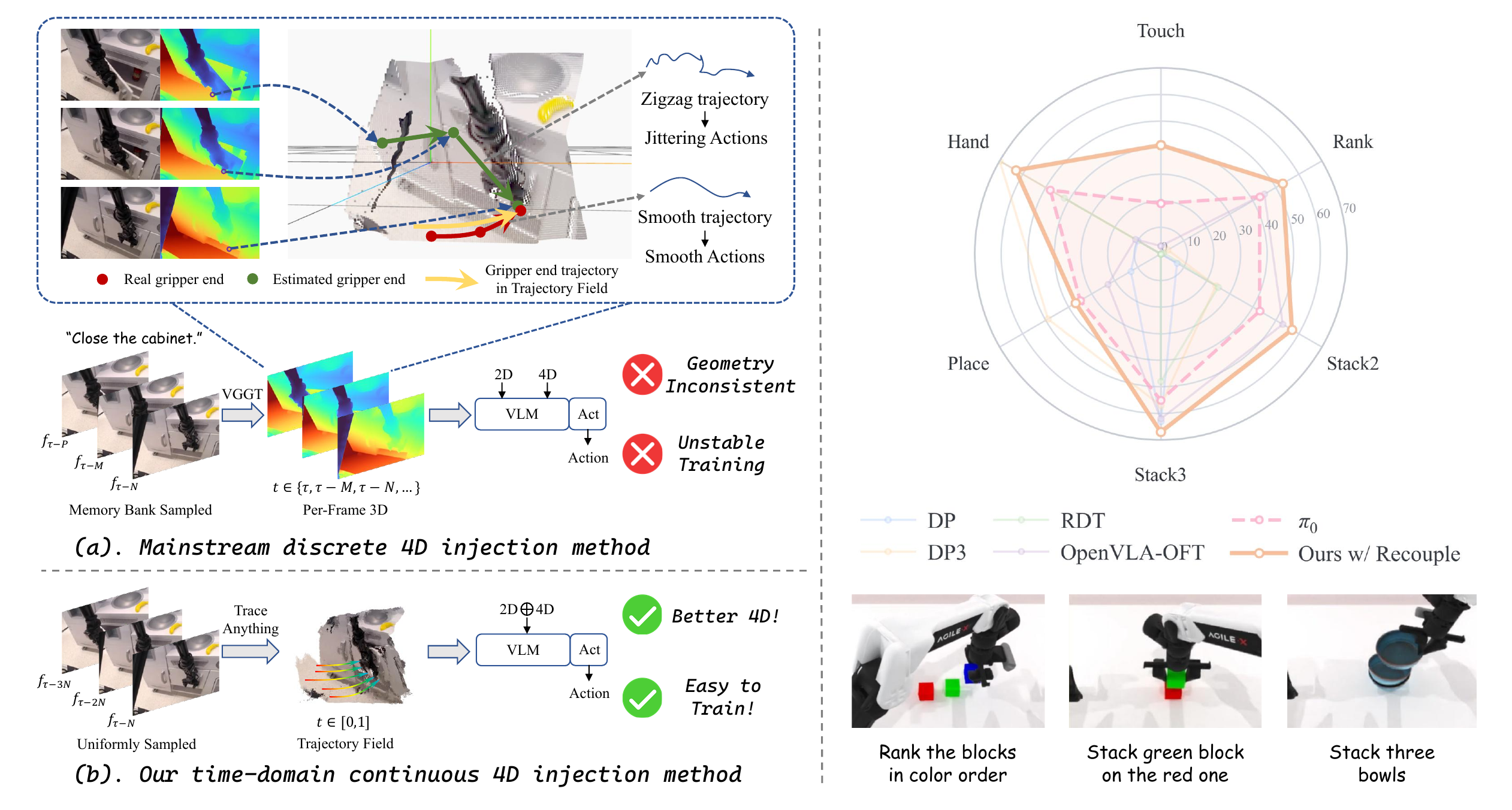
Motivation
Long-horizon manipulation is temporally ambiguous: the same current image can require continuing, stopping, or advancing a subgoal. Adding history alone does not solve this when the injected evidence is geometrically inconsistent or temporally fragmented.
MotionVLA converts a short, strictly past-only head-camera window into compact trajectory-field tokens. The policy retrieves only the motion evidence relevant to its current observation, preserving recent physical progress without flooding the VLA context with raw video.
A useful memory should tell the policy how it arrived here, not merely show it more images.
Method
The current frame stays in the VLA perception stream. Only earlier frames enter the frozen trajectory extractor.
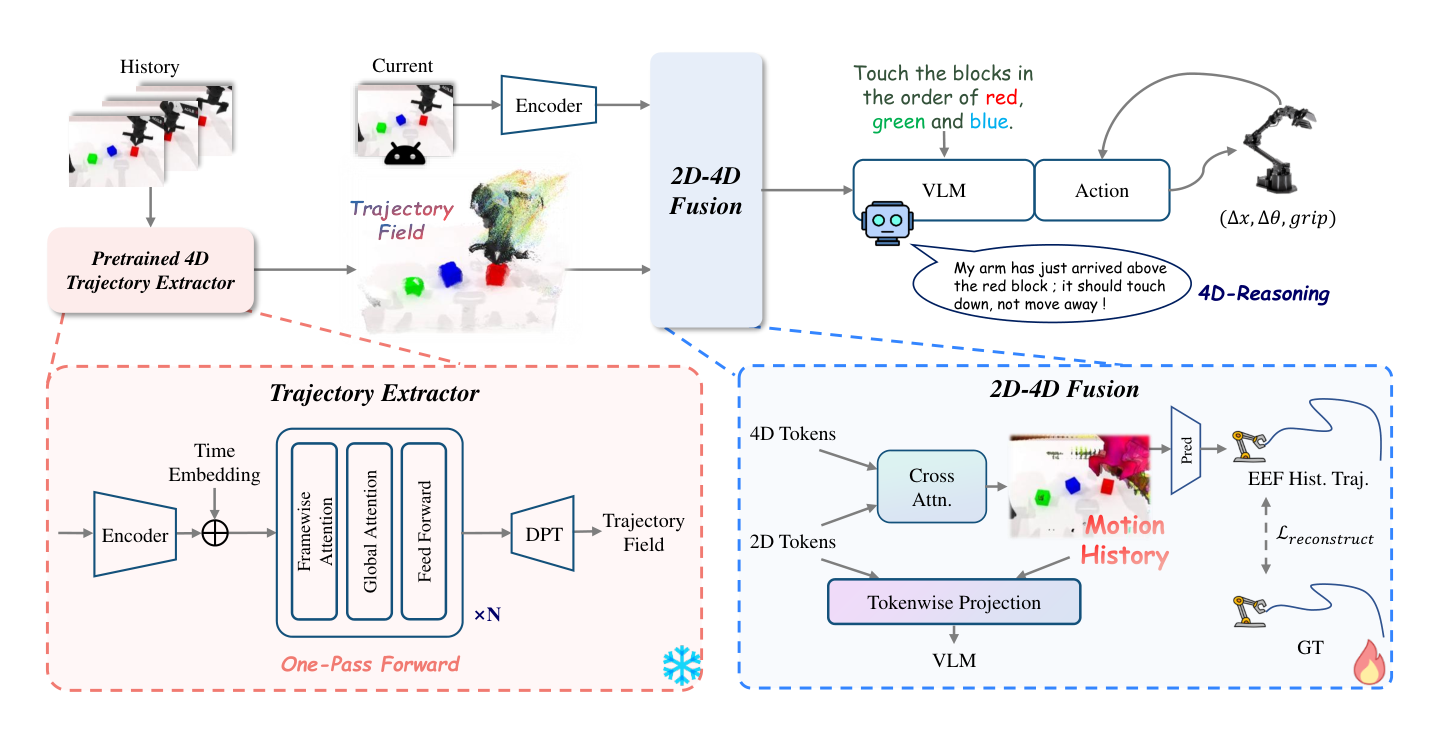
At time t, the current frame is excluded. The default 10 FPS history selects five frames with stride two and pads only from earlier observations.
A frozen TraceAnything encoder runs once on the sampled window. MotionVLA keeps final decoder tokens rather than expanding the dense trajectory field inside the policy.
Current head-camera tokens act as queries; normalized historical 4D tokens are keys and values. Cross-attention retrieves motion evidence aligned to what the policy sees now.
Historical EEF reconstruction keeps retrieved tokens dynamic. Recouple optionally mixes them back with current multi-view tokens before action generation.
Paper-reported results
Parenthetical deltas compare MotionVLA with π0.
RoboTwin2.0
LIBERO
Motion consistency
Path efficiency (PE) divides policy EEF travel by expert travel. Lower is better; 1.0 matches expert path length.
LIBERO
| Method | Goal | Long | ||
|---|---|---|---|---|
| SR ↑ | PE ↓ | SR ↑ | PE ↓ | |
| π0 | 95.8 | 1.23 | 85.2 | 1.19 |
| 4D-VLA* | 88.8 | 1.88 | 72.6 | 2.06 |
| 4D-VLA | 89.8 | 1.36 | 78.6 | 1.32 |
| MotionVLA | 96.2 | 1.05 | 91.2 | 1.10 |
PE is averaged only over successful episodes and is shown with SR. 4D-VLA* uses pseudo RGB-D predicted by Depth Anything 3.
Real Robot Experiments
Three temporally demanding tasks, with more than 100 demonstrations per task.
Agilex Piper
| Method | Pick & Place | Ranking | Touching | Average | ||||
|---|---|---|---|---|---|---|---|---|
| SR | Steps | SR | Steps | SR | Steps | SR | Steps | |
| Demonstration | — | 119 | — | 351 | — | 261 | — | 244 |
| π0 | 80.0 | 118 | 6.1 | 558 | 0.0 | — | 28.7 | 338 |
| MotionVLA | 92.5 | 119 | 18.2 | 443 | 15.0 | 285 | 41.9 | 282 |
Steps equal completion time × 10, rounded to the nearest integer. Unavailable task-level steps are excluded from each method's average; π0 has no Touching completion-step value.
Citation
@inproceedings{yuan2026motionvla,
  title     = {MotionVLA: Injecting Geometric Motion into Vision-Language-Action Model},
  author    = {Yuan, Shanglin and Zhao, Weiheng and Guo, Xianda and Sui, Wei and Yu, Li and Liu, Wenyu and Wang, Xinggang},
  booktitle = {Conference on Robot Learning (CoRL)},
  year      = {2026}
}